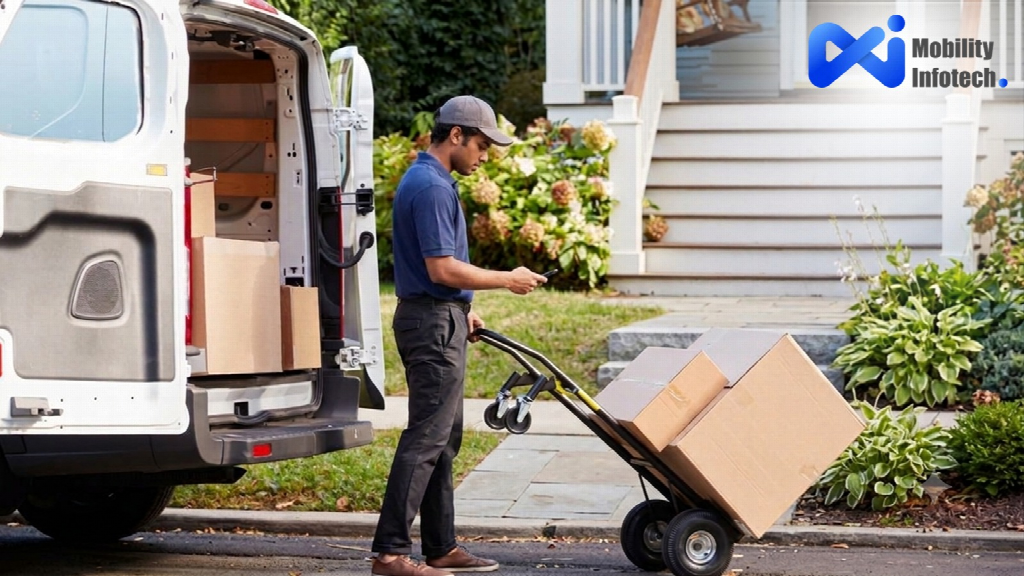
Take a last-mile delivery apart and look at where the money actually goes.
Labor is roughly half. Drivers earn $16 to $24 an hour and the industry was short more than 80,000 of them by 2025. Fuel is another 10% to 25%, worsened by vans averaging 6.5 miles per gallon and burning close to a gallon an hour idling in traffic. Maintenance adds about 20%.
Now notice what is not in that list. None of it is the package.
Every major cost in the final leg is a cost of time and motion, which is why the last mile consumes 53% of total shipping spend while covering only 3% to 8% of the distance. And it keeps climbing: U.S. delivery costs rose about 12% from 2024 to 2025.
Software cannot lower a driver’s wage or the price of diesel. What it can do is change how many completed stops each paid hour produces. That is the entire argument for last mile delivery route planning, and here are the ten places it shows up.
Before the wheels turn
Most last-mile losses are locked in before anyone leaves the building. Good last mile routing and scheduling software attacks them at the planning stage.
1. Address validation at order capture.
Bad addresses are a top cause of failed delivery, and a wrong pin does not announce itself until a driver is parked outside the wrong house. Geocoding at intake kills the failure a day early, when fixing it costs a phone call instead of a truck roll.
2. Service times based on evidence, not averages.
A flat five minutes per stop guarantees the schedule drifts by mid-morning. Software that learns actual dwell time by location type builds a plan that survives the day.
3. Sequencing no person can do by hand.
A delivery route planner with multiple stops evaluates orderings a dispatcher cannot, then layers time windows, access rules and traffic on top. On a 120-stop route, cutting one wasted mile per stop removes more than a full day of driving each week.
4. Load and vehicle matching.
Last mile fleet route optimization pairs each route with the right truck and fills it properly. Suburban operators target 15 to 20 stops an hour and rural routes 8 to 12, and hitting those densities is a loading decision as much as a routing one.
Once the vehicles are moving
A plan is a prediction. The next three capabilities decide what happens when the prediction is wrong.
5. Replanning in flight.
Real-time delivery route optimization redistributes stops when a van breaks down, tightens the sequence when an order cancels and reroutes around a closure without waiting for a dispatcher to notice. The plan stays current instead of degrading hour by hour.
6. Proactive ETAs the customer can act on.
Most failed deliveries happen because nobody is home, not because the route was wrong. A text with a live window and one-tap rescheduling converts a wasted trip into a completed one. It also cuts the “where is my order” calls consuming your support team.
7. A driver app that removes friction.
Turn-by-turn guidance to the correct entrance, sequenced stop lists, barcode scanning, one-handed status updates. Minutes recovered per stop compound across 120 stops in a way no single efficiency project matches.
After the last stop
The final three are where operations either learn or repeat themselves.
8. Proof of delivery that ends disputes.
Timestamped, GPS-tagged photo and signature capture settles a claim in seconds. Disputes cost real money to resolve, and the ones you cannot prove get written off.
9. Planned versus actual analysis.
The gap between the route you built and the route that ran is the most useful data in the operation. It exposes customers whose service times are understated, zones that are chronically over-scheduled and drivers who need support rather than pressure. Feed that back into last mile delivery route planning and next month’s plan starts closer to reality.
10. Peak capacity without permanent headcount.
November through January can lift daily route rates 40% to 60%. Systems that absorb temporary vehicles, seasonal drivers and gig capacity let you scale for eight weeks without carrying that cost for twelve months.
What this looks like in practice
None of these ten is transformative alone. Address validation saves a few failed stops. Better sequencing trims a few miles. Photo proof closes a few disputes.
Together they change the unit economics, because they all pull on the same lever: more completed stops per paid hour. That is why 85% of U.S. retail executives named cost per order their top last-mile priority, and why three in four admitted home delivery does not currently add to profitability.
Platforms such as Mobility Infotech Logistics are built around that full sequence rather than one slice, combining constraint-based planning, live re-optimization, driver tools and customer notifications, with low-code connectors into the ERP, OMS or TMS you already run.
The operations pulling ahead are not the ones with the largest fleets. They are the ones treating last mile delivery route planning as an operating system rather than a mapping tool, and measuring the result in cost per stop instead of miles saved.
If you want that number for your own routes before committing to anything, Mobility Infotech Logistics’ ROI calculator is a reasonable first hour to spend.