Businesses today are increasingly adopting automation technologies to improve efficiency, reduce manual work, and make smarter decisions. Platforms like Cflow help organizations streamline processes and manage operations through intelligent automation. Understanding AI workflows vs AI agents for business automation decisions is essential for companies looking to choose the right automation approach for their needs.
Many organizations also depend on a Workflow solutions consultant to design and implement efficient workflow systems that align with business goals. By combining the right tools, expertise, and automation strategies, businesses can improve productivity and achieve better operational results.
As automation technologies evolve, organizations often face confusion when choosing between AI workflows and AI agents. While both aim to improve business efficiency, they function differently and offer unique benefits. Understanding these differences helps businesses make smarter automation decisions.
What Is Business Process Automation?
Business process automation involves using technology to perform tasks with minimal human involvement. It helps organizations reduce manual work, improve accuracy, and speed up operations. Automation can be applied to approvals, data management, customer support, employee processes, and more.
Modern workflow automation platforms use artificial intelligence (AI) to enhance these processes. AI can analyze data, predict outcomes, and automate complex decisions. This is where AI workflows and AI agents play an important role in business automation.
Understanding AI Workflows
AI workflows are structured and rule-based processes that use artificial intelligence to automate specific tasks within a defined sequence. These workflows follow predefined logic and conditions to complete tasks automatically.
For example, an AI workflow can automatically route approval requests, process invoices, send notifications, or analyze data based on set rules. The workflow follows a clear path, ensuring consistency and accuracy.
Key features of AI workflows include:
- Structured processes: Tasks follow predefined steps and logic.
- Predictable outcomes: Results are consistent because the process is rule-driven.
- Process automation: Ideal for repetitive and standardized tasks.
- Integration capabilities: Works with existing business systems and tools.
- Improved efficiency: Reduces manual intervention and errors.
AI workflows are best suited for organizations that need consistency, compliance, and efficiency in routine operations such as HR processes, finance approvals, and customer onboarding.
Understanding AI Agents
AI agents are intelligent systems that can act independently, make decisions, and learn from data. Unlike AI workflows, AI agents are not limited to predefined rules. They can analyze situations, adapt to new conditions, and perform tasks dynamically.
For example, an AI agent can handle customer queries, recommend actions, analyze business performance, or optimize processes without constant human input. These agents use machine learning and data analysis to improve performance over time.
Key features of AI agents include:
- Autonomous decision-making: Can act independently without strict rules.
- Learning capability: Improves performance through data and experience.
- Adaptability: Responds to changing business environments.
- Complex problem-solving: Handles dynamic and unpredictable tasks.
- Continuous optimization: Enhances processes automatically.
AI agents are useful for complex operations such as predictive analytics, intelligent customer support, and decision-driven processes.
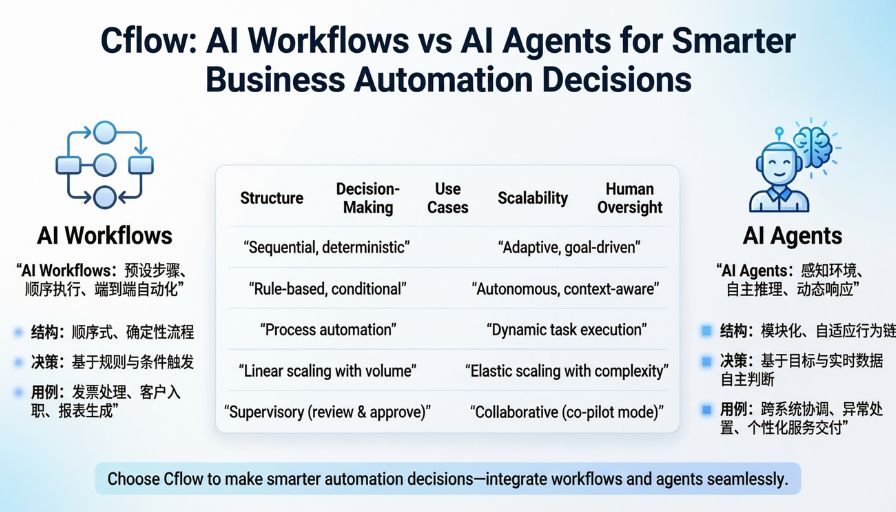
AI Workflows vs AI Agents: Key Differences
Understanding the differences between AI workflows and AI agents helps businesses choose the right automation strategy.
- Process Structure
AI workflows follow predefined rules and structured processes, while AI agents operate more independently and adapt to situations. - Decision-Making Ability
AI workflows make decisions based on programmed logic. AI agents make intelligent decisions using data and learning. - Level of Flexibility
AI workflows are less flexible but highly reliable for routine tasks. AI agents are highly flexible and suitable for dynamic environments. - Use Cases
AI workflows are best for repetitive processes like approvals and document management. AI agents are suitable for complex tasks such as analysis and predictive decision-making. - Implementation Complexity
AI workflows are easier to implement and manage. AI agents require more advanced setup and monitoring.
Both technologies play important roles in business automation, and organizations often benefit from using them together.
How Cflow Supports Smarter Automation
Cflow provides a no-code workflow automation platform that helps businesses design and manage automated processes easily. It enables organizations to build AI-powered workflows that streamline operations, improve collaboration, and reduce manual work.
With Cflow, businesses can:
- Automate approval workflows and document processes.
- Manage employee lifecycle processes.
- Improve process visibility with real-time tracking.
- Integrate systems and applications seamlessly.
- Enhance productivity with intelligent automation.
By combining structured workflows with intelligent automation capabilities, Cflow helps organizations achieve greater efficiency and better operational control.
Choosing Between AI Workflows and AI Agents
The choice between AI workflows and AI agents depends on business needs, process complexity, and automation goals.
Businesses should choose AI workflows when:
- Tasks are repetitive and rule-based.
- Consistency and compliance are important.
- Processes follow a clear structure.
- Implementation needs to be simple and quick.
Organizations should consider AI agents when:
- Processes require independent decision-making.
- Business environments change frequently.
- Tasks involve complex analysis or prediction.
- Continuous learning and optimization are needed.
Many organizations adopt a hybrid approach by using AI workflows for structured tasks and AI agents for intelligent decision-making. This combination provides both efficiency and flexibility.
Role of Workflow Experts in Automation Success
Implementing AI-powered automation requires proper planning and expertise. A workflow solutions consultant helps organizations analyze processes, identify automation opportunities, and implement suitable solutions. Their expertise ensures that businesses select the right technology, design efficient workflows, and maximize automation benefits.
With professional guidance, organizations can avoid implementation challenges and achieve faster digital transformation.
Conclusion
AI-powered automation is transforming how businesses operate and make decisions. Understanding the differences between AI workflows and AI agents helps organizations choose the right approach for improving efficiency and productivity. AI workflows provide structured and reliable process automation, while AI agents offer intelligent decision-making and adaptability.
Platforms like Cflow help businesses implement smart automation strategies by simplifying workflow management and improving operational efficiency. By combining the right automation tools, expert guidance, and clear business goals, organizations can build smarter processes, enhance productivity, and stay competitive in a rapidly changing digital environment.