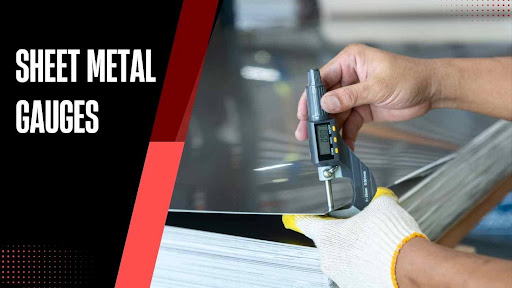
Manufacturers and sheet metal suppliers use sheet metal gauge to specify the sheet thickness. It is not a regular metric or standard system, but instead a global practice of defining thickness by a number based on weight per unit area.
Engineers, designers, and fabricators use gauge to communicate in cutting, bending, stamping, machining, and other processes. The upcoming sections will discuss the uses of gauges, accompanied by an illustration of a sheet metal gauge chart.



What is a Sheet Metal Gauge?

The thickness gauge number runs from 3 to 36; the lower the gauge number, the thicker the sheet. For example, a 16 gauge sheet metal thickness is higher than 20 gauge. However, remember that the corresponding thickness of a gauge in mm or inches varies from one metal to another.
Since gauges are based on the weight of specific materials instead of exact thickness in millimeters or inches, you need to convert them for precision during design and fabrication. For this, use the gauge chart of that same metal or alloy. Additionally, you can also do conversions using online mm to gauge converters.
How to Choose the Right Sheet Metal Gauge for Fabrication?
Choosing the right sheet metal gauge is essential for the functionality and durability of fabricated items. It also impacts the material cost and efficiency of the fabrication process.
Consider the following factors while choosing the correct sheet metal gauge to fabricate the desired parts & products.
- Choose the Metal First: Since the gauge number varies based on the material type, consider which metal sheet you are using.
- Required Strength: Consider the necessary strength and load-bearing capacity for the application; lower gauge means thicker sheets and high strength.
- Desired Tolerances: Thinner sheets are more prone to springback effects, so ensure the chosen thickness does not affect the desired tolerances while forming.
- Fastening and Assembly: Consider the assembly requirements, as a certain thickness is necessary for screw fastening, welding, and other assembly techniques
- Fabrication Method: Thickness limitations in fabrication differ from one forming method to another, so ensure the gauge thickness is compatible with the forming methods you will use.
Sheet Metal Gauge Chart
The gauge chart is different for each type of sheet metal. When you are doing a conversion, you must look at the column of the corresponding metal or the chart of that specific metal.
The table below combines stainless steel, aluminum, copper, and steel sheet metal gauge charts.
| Gauge | Mild Steel | Aluminum | Stainless Steel | Galvanized Steel | Copper | |||||
| Inches | mm | Inches | mm | Inches | mm | Inches | mm | Inches | mm | |
| 7 | 0.1793 | 4.554 | 0.1443 | 3.665 | — | — | — | — | 0.18 | 4.572 |
| 8 | 0.1644 | 4.175 | 0.1285 | 3.264 | 0.17187 | 4.365 | 0.1681 | 4.269 | 0.165 | 4.191 |
| 9 | 0.1495 | 3.797 | 0.1144 | 2.906 | 0.15625 | 3.968 | 0.1532 | 3.891 | 0.148 | 3.759 |
| 10 | 0.1345 | 3.416 | 0.1019 | 2.588 | 0.14062 | 3.571 | 0.1382 | 3.51 | 0.134 | 3.404 |
| 11 | 0.1196 | 3.038 | 0.09074 | 2.305 | 0.125 | 3.175 | 0.1233 | 3.1318 | 0.12 | 3.048 |
| 12 | 0.1046 | 2.656 | 0.08081 | 2.053 | 0.10937 | 2.778 | 0.1084 | 2.753 | 0.109 | 2.769 |
| 14 | 0.0747 | 1.897 | 0.06408 | 1.628 | 0.07812 | 1.984 | 0.0785 | 1.9939 | 0.083 | 2.108 |
| 16 | 0.0598 | 1.518 | 0.05082 | 1.291 | 0.0625 | 1.587 | 0.0635 | 1.6129 | 0.065 | 1.651 |
| 18 | 0.0478 | 1.214 | 0.0403 | 1.024 | 0.05 | 1.27 | 0.0516 | 1.31 | 0.049 | 1.245 |
| 20 | 0.0359 | 0.911 | 0.03196 | 0.812 | 0.0375 | 0.9525 | 0.0396 | 1.005 | 0.035 | 0.889 |
| 22 | 0.0299 | 0.759 | 0.02535 | 0.644 | 0.03125 | 0.7937 | 0.0336 | 0.853 | 0.028 | 0.711 |
| 24 | 0.0239 | 0.607 | 0.0201 | 0.511 | 0.025 | 0.635 | 0.0276 | 0.701 | 0.022 | 0.559 |
| 26 | 0.0179 | 0.454 | 0.01594 | 0.405 | 0.01875 | 0.476 | 0.0217 | 0.551 | 0.018 | 0.457 |
| 28 | 0.0149 | 0.378 | 0.01264 | 0.321 | 0.01562 | 0.396 | 0.0187 | 0.474 | 0.014 | 0.356 |
| 30 | — | — | 0.01003 | 0.255 | 0.0125 | 0.3175 | 0.0157 | 0.398 | 0.012 | 0.305 |
Standard Sheet Metal Sizes
Raw sheet metals come in different standard sizes, like 48″ × 96″ ( 1220 × 1438 mm), 48″ × 120″ (1220 x 3048 mm), and 60″ × 120″ (1524 mm × 3048 mm). Meanwhile, the gauge number defines their thickness.
However, the sheet sizes may differ from one supplier to another. Therefore, ask your supplier or fabricator to provide the details of standard sheet metal sizes and thickness.



Conclusion
Sheet metal gauges are important in sheet metal services for communicating the sheet thickness among engineers, designers, fabricators, and metal suppliers. They consider the density of material while defining the thickness, which helps to ensure consistent strength, weight, and performance. However, it is essential to convert them into mm or inches during design and fabrication for accuracy.
FAQs
What is the gauge scale for sheet metal?
A gauge scale is a system for defining metal thickness in numbers. Lower gauges refer to thicker sheets, and higher gauges mean thinner sheets.
Does 20 gauge steel rust easily?
Yes, the sheets of steel with gauge 20 rust easily if they are not heat-treated, especially in moist and harsh environments.