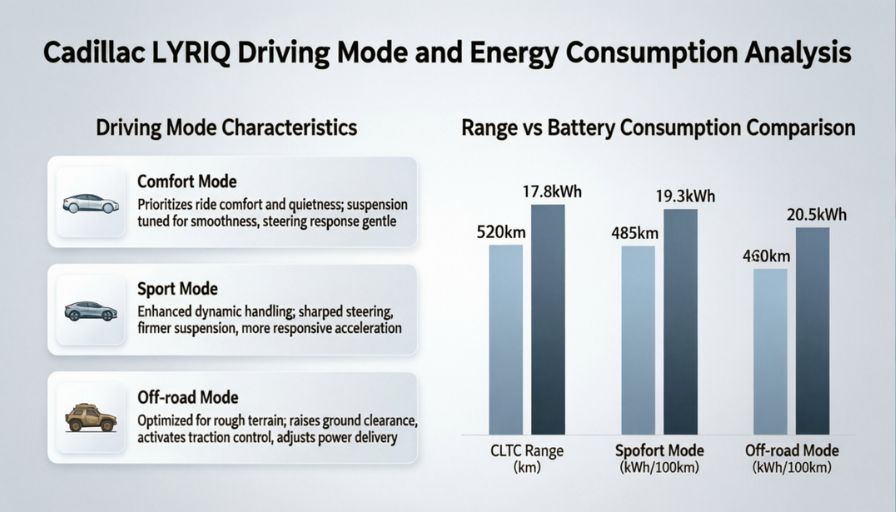
If you own or are considering a Cadillac Lyriq, you have probably noticed there are multiple driving modes available: Tour, Sport, Snow/Ice, My Mode, and in some cases Velocity Mode. A question that comes up constantly among Lyriq owners is whether these modes actually change how far the car can go on a single charge, or whether they are mostly about ride feel and steering response.
The answer is yes, driving modes do affect range and battery usage, but not because the battery changes. The 102 kWh Ultium battery pack is exactly the same in every mode. What changes is how aggressively the software draws energy from that pack, and how much of it gets recovered during deceleration. Depending on your mode choice and driving habits, that difference can add up to anywhere from 20 to 60 miles on a full charge.
This article breaks down what each mode actually does at a technical level, what real-world range figures look like, and how to use modes strategically to get the most out of your Lyriq.
What Stays the Same Across All Modes
Before getting into the modes themselves, it helps to know what never changes. The Cadillac Lyriq uses a 102 kWh Ultium battery pack across all trims and configurations. No mode alters the physical battery capacity, its chemistry, or the total energy available for a given trip. What modes control is how that energy is requested, delivered, and recovered.
To put numbers to the baseline, here are the EPA-rated and real-world range figures for the different Lyriq configurations, all tested in Tour Mode:
| Configuration | Drivetrain | EPA Range | Real-World Range |
|---|---|---|---|
| Lyriq RWD | Single motor, 340 hp | 314 to 326 miles | 255 to 270 miles |
| Lyriq AWD | Dual motor, 500 hp | 307 miles | 220 to 250 miles |
| Lyriq-V AWD | Dual high-output motors | ~285 miles | 230 to 250 miles |
Car and Driver achieved 270 miles on a highway range test with the RWD model. Slashgear’s reviewer averaged about 2.5 miles per kWh in mixed driving, which projects to roughly 255 miles of practical range. These numbers become your reference point when evaluating how much each mode takes off, or occasionally adds to, your total range.
How Driving Modes Work Under the Hood
The Cadillac Lyriq’s Driver Mode Control system is accessed through the 33-inch curved infotainment display. Cadillac’s own documentation describes it as a system that adjusts various vehicle systems based on driving preferences, weather, and road conditions. That description is accurate, but it undersells how much is actually happening when you switch modes.
Three core systems get recalibrated with every mode change:
- Throttle mapping: This determines how much torque is delivered relative to pedal position. A softer mapping means the motor ramps up gradually. An aggressive mapping means a light press of the accelerator commands an immediate surge of power and a corresponding spike in battery draw.
- Regenerative braking behavior: Every time the Lyriq decelerates, the electric motors can reverse their function and push energy back into the battery. How strongly regen is applied, and how consistently, varies by mode and has a measurable impact on net energy consumption over a full trip.
- Traction and stability control thresholds: Especially relevant in Snow/Ice Mode and on AWD models, where the system controls how torque is split between axles and how aggressively traction intervention kicks in.
All three of these systems working together determine your real-world efficiency. A mode that spikes torque demand frequently and recovers less energy through regen will always produce lower range than a mode that manages both smoothly.
Tour Mode: The Range Baseline
Tour Mode is the factory default and the mode that all EPA testing is conducted in. That alone tells you something important: it is calibrated for maximum everyday efficiency without sacrificing comfort. Throttle response is progressive and linear, meaning the motor ramps up power gradually as you press the accelerator. Regenerative braking is active and consistent, recovering energy on every deceleration without the abrupt feel some drivers find uncomfortable.
In normal conditions, including city commuting, mixed traffic, and moderate highway driving, Tour Mode gives you the closest real-world performance to the advertised EPA figure. It is also the mode the Lyriq automatically returns to on restart if you were previously in Snow/Ice Mode, which reflects Cadillac’s intent that this is the default all-purpose setting.
If range matters on a given trip, Tour Mode is the right choice. There is no other mode that consistently delivers better efficiency under everyday conditions.
Sport Mode: Performance Costs You Range
Sport Mode is where things get interesting from a range perspective. The throttle mapping changes significantly. A smaller pedal input commands a much larger torque response. Steering weight increases. The suspension firms up. The Lyriq genuinely feels different: more immediate, more athletic, noticeably quicker off the line.
The cost is straightforward. Because Sport Mode front-loads torque delivery, every acceleration event draws a higher current spike from the battery. In a single instance that difference is small. But over an urban drive with frequent stops and starts, or a spirited run with regular hard accelerations, those spikes accumulate into a meaningful range reduction.
Real-world data from Lyriq owners suggests Sport Mode typically reduces efficiency by 15 to 25 percent compared to Tour Mode. On the AWD model with an EPA rating of around 307 miles, that translates to a realistic range of roughly 230 to 260 miles depending on how aggressively you drive within the mode. The range impact is also conditional. Moderate drivers using Sport Mode on a steady highway run may see only a modest reduction, while urban driving with repeated hard launches will show the full penalty.
Sport Mode is best reserved for short drives where the dynamic experience is the point, not the destination distance.
Snow and Ice Mode: Safety First, Efficiency Second
Snow/Ice Mode exists for one purpose: keeping the car stable and controllable on low-traction surfaces. To achieve that, it deliberately softens throttle response to prevent wheel spin during acceleration. Traction control thresholds tighten considerably. On AWD models, torque distribution between front and rear axles is recalibrated to bias toward whichever wheels have the best grip at any given moment.
On actual snowy or icy roads, this mode can be more energy-efficient than driving in any other mode, because uncontrolled wheel spin wastes both energy and traction. The energy that would have gone into spinning a wheel uselessly gets directed elsewhere. On dry roads, however, Snow/Ice Mode introduces a small but measurable efficiency penalty because the system is working harder than it needs to for the conditions. Cadillac notes directly that using this mode on clear, dry pavement can result in poorer acceleration.
Range reduction compared to Tour Mode on dry roads is typically in the 5 to 15 mile range. That is modest and a reasonable trade-off given the safety benefits when conditions actually call for it.
My Mode: The Variable You Control
My Mode is the most interesting option from an efficiency standpoint because the range impact is entirely determined by how you configure it. Through the infotainment display you can individually adjust throttle response, steering weight, brake feel, regenerative braking intensity, and suspension firmness. You can also adjust the ambient motor sound inside the cabin. The settings are saved and persist across ignition cycles.
Configure it toward performance settings and My Mode behaves similarly to Sport Mode in terms of battery draw. Configure it toward comfort and efficiency settings and it can closely match, or in some real-world driving conditions actually exceed, Tour Mode efficiency. Some owners have found that setting throttle response to its softest setting while maximizing regenerative braking strength creates a custom profile that outperforms Tour Mode in stop-and-go city driving, with efficiency figures of 4.0 to 4.3 miles per kWh reported in urban environments.
My Mode rewards experimentation. If you have specific preferences such as softer suspension but sharper steering, you can tune those independently without accepting the full Sport Mode energy penalty.
Velocity Mode: Optional Performance Upgrade
Velocity Mode is an optional upgrade available for purchase at $1,200, installed via over-the-air update. It is not included with the standard Lyriq and replaces Sport Mode rather than adding to it. The key difference is an additional 74 pound-feet of torque, which reduces the zero-to-60 time from 4.7 seconds to 4.4 seconds under optimal conditions.
From a range perspective, Velocity Mode sits at the high end of battery consumption among the available modes. Its purpose is maximum performance, not efficiency, and the range implications reflect that. The car reverts to Tour Mode on restart when Velocity Mode has been active, consistent with Cadillac’s approach of defaulting to the most range-friendly setting unless the driver actively chooses otherwise.
Mode-by-Mode Range Comparison
The following figures are based on owner data, automotive journalist testing, and real-world reports. Cadillac does not publish official mode-specific range ratings.
| Mode | Range vs. Tour Mode | Estimated Miles Lost | Best Suited For |
|---|---|---|---|
| Tour Mode | Baseline | 0 miles | Daily driving, long trips |
| My Mode (efficiency settings) | Equal or slightly better | 0 to 5 miles | Personalized efficient driving |
| Snow / Ice Mode | Slight reduction on dry roads | 5 to 15 miles | Winter, icy and wet roads |
| Sport Mode | Noticeable reduction | 20 to 50 miles | Short spirited drives |
| Velocity Mode | Largest reduction | 30 to 60 miles sustained | Performance driving only |
What Affects Range More Than Any Driving Mode
Driving mode selection is one lever among several that determine your real-world range. In many situations, external conditions and driving behavior have a larger impact than the mode itself.
| Factor | Range Impact | Notes |
|---|---|---|
| Highway speeds above 75 mph | -15 to -20% | Car and Driver recorded 270 miles on highway vs. 314 EPA rated |
| Cold weather below 20°F | -20 to -40% | Reduced battery capacity plus high cabin heating demand |
| 22-inch wheels vs. 19-inch | -3 to -5% | Consistently cited as the top range complaint in owner surveys |
| Heavy HVAC use | -5 to -15% | Preconditioning while plugged in significantly reduces this |
| Smooth throttle habits | Up to +20% | Drivers who anticipate stops and avoid hard launches frequently exceed EPA estimates |
The practical implication is that a skilled driver in Sport Mode on a mild day, driving smoothly, can easily outperform an inattentive driver in Tour Mode on a cold highway. Mode choice matters, but it does not override everything else.
Tips for Getting the Most Range From Your Lyriq
- Use Tour Mode as your default for any trip where range matters. It is calibrated closest to EPA conditions and gives you the most predictable, consistent efficiency.
- Learn One-Pedal Driving in city traffic. Lifting off the accelerator brings the car to a complete stop using regenerative braking alone. In stop-and-go conditions, this feature recovers more energy per mile than almost any other single habit change.
- Use the Regen on Demand paddle. The steering wheel paddle lets you trigger stronger regenerative braking on demand without committing to a full One-Pedal setup. It is useful on downhill stretches or approaching intersections.
- Charge to 80 percent for daily use. Cadillac recommends this for battery longevity, but it also preserves headroom for regen recovery. The system captures more energy when the battery has space to accept it.
- Precondition before cold-weather drives. Using the myCadillac app to heat or cool the cabin while the car is still plugged in means that energy comes from the grid, not the battery. This alone can preserve meaningful range on cold mornings.
- Build a My Mode efficiency profile. Set throttle response soft, regenerative braking high, and steering at your preferred weight. Save it as a custom profile you can switch to on long commutes without giving up your preferred sport settings on weekends.
Frequently Asked Questions
Do the driving modes in Cadillac Lyriq offer different ranges or battery usages?
Yes. Each mode adjusts throttle response, regenerative braking behavior, and traction control calibration, all of which directly affect how quickly the 102 kWh battery is drained. The difference between Tour Mode and sustained Sport Mode use can reach 20 to 50 miles on a single charge, depending on driving style and conditions.
Which driving mode gives the best range in the Cadillac Lyriq?
Tour Mode gives the best range under normal conditions because it is the mode EPA testing is conducted in and it is optimized for smooth, efficient power delivery. However, a well-configured My Mode profile with maximum regenerative braking and soft throttle settings can match or slightly exceed Tour Mode efficiency in heavy city traffic.
How much range does Sport Mode reduce in the Cadillac Lyriq?
Based on real-world owner data, Sport Mode typically reduces efficiency by 15 to 25 percent compared to Tour Mode. On the AWD Lyriq with a 307-mile EPA rating, that means a realistic range of approximately 230 to 260 miles depending on how aggressively you drive in the mode.
Does switching driving modes damage the Lyriq battery?
No. The battery management system is designed to safely handle all driving modes without degrading cell health. The thermal management system protects the battery regardless of which mode is active, and switching modes causes no harm to the battery pack.
Can I switch driving modes while the car is moving?
Yes. The Lyriq allows mode changes at any speed through the infotainment touchscreen. The transition is immediate and smooth. The new mode’s throttle and handling calibration takes effect right away without interrupting power delivery.
Does Snow/Ice Mode reduce range even when roads are dry?
Yes, slightly. Snow/Ice Mode is calibrated for low-traction surfaces, and using it on dry, clear roads means the system is managing power delivery more conservatively than necessary. Cadillac specifically notes that this mode can result in poorer acceleration on clear pavement. The range reduction is modest, around 5 to 15 miles, but there is no reason to use the mode when roads are dry.
Is Velocity Mode available on all Cadillac Lyriq models?
No. Velocity Mode is an optional purchase at $1,200, available on equipped models via over-the-air update. It is not included as a standard feature and is not the same as the Velocity Max Mode exclusive to the LYRIQ-V performance variant.
Does AWD use more battery than RWD in every mode?
Generally yes. The AWD system adds weight and occasionally engages the front motor, increasing drivetrain losses. The EPA difference is approximately 7 miles between the RWD and AWD configurations in Tour Mode. In Sport Mode and other high-demand modes, the gap can widen due to more aggressive dual-motor engagement.