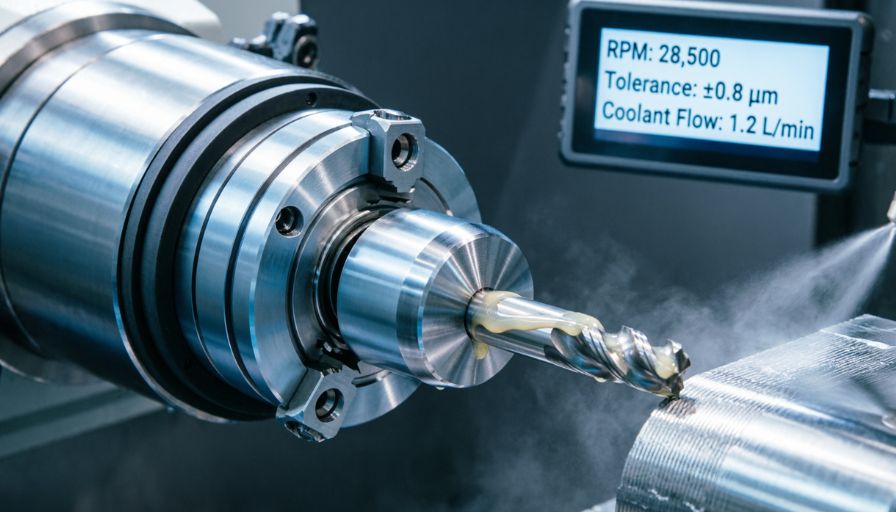
It is not, however, any more confined these days to just cutting large volumes of metal or carving hefty pieces in the process. The industry has evolved into an age in which components are becoming smaller, tolerances closer and surface finishes tighter. Medical implants, electronics housing and aerospace micro-components Manufacturers are now working in a world of microns.
And, as sophisticated CNC machines and high-speed spindles so often seem to steal the show, there’s another hero that quietly performs much of the heavy lifting behind the scenes: tool holders.
 Supporting Children with Kindness and Patience
 Heavy-Duty Roofing Screws: Why Quality Matters for Longevity
 Could Space Mining Solve Earth’s Resource Crisis?
These simple looking screw elements are the “bridge” between your machine and the cutting instrument. In high-precision and micro-machining, that relationship determines whether a process is smooth sailing or an exercise in throwaway scrap, vibration and time.
Read on for a detailed look at how today’s tool holding is enabling ultra-precise machining, why selecting the proper holder has never been more important, and how concepts like the hydraulic tool holder and precision tool holder design are redefining manufacturing.
Why Tool Holders Matter in High-Precision Machining
In conventional machining, small inaccuracies in tool holding might go unnoticed. But in micro-machining, even a few microns of runout can ruin an entire part.
 Designed for Sleep, Built for Life The RingConn Gen 2 Air Smart Ring
 How to Use Social Media for Marketing of Drug Testing Products
 Tractor Supply Sales Associate Job Description: Full Career Guide
Here’s the thing, your cutting tool is only as good as the holder supporting it.
Modern tool holders are responsible for:
- Maintaining concentricity
- Absorbing vibration
- Ensuring repeatable positioning
- Delivering stable clamping force
If any of this fail, surface finish suffers, tools wear out faster, and dimensional accuracy drops.
In high-precision environments, the holder isn’t just an accessory anymore. It becomes a performance component.
The Shift Toward Micro-Machining
Micro-machining focuses on producing extremely small and detailed components, often with tolerances below 10 microns. Industries such as medical devices, semiconductors, optics, and aerospace depend on this level of accuracy.
But cutting tiny features requires more than sharp tools. It demands absolute stability across the entire machining system. That’s where advanced holders come into play.
Traditional holders simply can’t deliver the balance and vibration damping required at high spindle speeds. Modern designs, however, are engineered specifically for micro-scale performance.
Understanding the Role of a Precision Tool Holder
A precision tool holder is designed to minimize runout while maximizing rigidity. These holders typically offer:
- Extremely low radial deviation
- Balanced construction for high RPM
- Uniform clamping pressure
- Strong vibration damping
This combination ensures cutting edges stay exactly where they should be, even during aggressive high-speed operations.
For micro-tools, where diameters can be smaller than a millimeter, this accuracy is non-negotiable. Any imbalance instantly translates into chatter or tool breakage.
That’s why precision holders are now standard in advanced machining centers rather than optional upgrades.
Hydraulic Tool Holders: A Game Changer for Micro-Machining
Among modern solutions, the hydraulic tool holder stands out as one of the most reliable choices for high-precision work.
Instead of mechanical tightening, hydraulic holders use pressurized fluid to apply even clamping force around the tool shank. This delivers several advantages:
- Ultra-low runout (often under 3 microns)
- Excellent vibration absorption
- Consistent grip along the full circumference
- Fast and simple tool changes
Because pressure is distributed evenly, tools experience less localized stress. That translates into longer tool life and cleaner surface finishes.
For finishing passes, micro-drilling, and fine contouring, hydraulic holders are often the first choice in modern workshops.
Milling Machine Tool Holders in High-Accuracy Operations
Every milling process relies heavily on the stability of the milling machine tool holder. In micro-machining, this becomes even more critical.
Modern milling holders are engineered for:
- High rigidity during side loads
- Balanced rotation at elevated spindle speeds
- Minimal deflection under cutting pressure
Advanced designs also include internal damping features that reduce vibration during fine cuts. This helps maintain consistent chip loads and prevents premature tool failure.
Whether roughing tiny pockets or finishing intricate profiles, a quality milling holder ensures that the spindle’s power is transferred cleanly to the cutting edge.
Grip Tool Holders and Their Role in Stability
Grip tool holders are designed to provide exceptionally strong mechanical clamping. They are commonly used where torque transmission is important, especially during heavier cuts.
In micro-machining environments, grip holders are often combined with precision balancing to deliver both strength and stability. Their key benefit lies in preventing tool pull-out during aggressive operations while maintaining acceptable accuracy.
Although they don’t always achieve the same low runout as hydraulic designs, grip holders still play an important role in applications that demand high holding force.
Why Runout Control Is Everything
Runout is one of the biggest enemies of micro-machining.
Even a tiny amount can cause:
- Uneven tool wear
- Poor surface finish
- Dimensional inaccuracies
- Sudden tool breakage
Modern tool holders are manufactured with extremely tight tolerances to reduce runout at the spindle interface. Combined with balanced designs, this ensures stable cutting at speeds exceeding 30,000 RPM.
This level of control allows manufacturers to push feed rates higher without sacrificing accuracy.
Vibration Damping: The Hidden Advantage
Micro-tools are fragile by nature. Any vibration quickly turns into chipping or catastrophic failure. That’s why vibration damping has become a major design focus for modern holders.
The hydraulic tool holder, in particular, excels here. Its internal fluid absorbs micro-vibrations before they reach the cutting edge. This produces smoother finishes and extends tool life significantly.
Less vibration also means less noise, better dimensional consistency, and fewer rejected parts.
Supporting Automation and Smart Manufacturing
Today’s machining environments are increasingly automated. Tool holders must now integrate seamlessly with robotic tool changers, presetting systems, and digital workflows.
Modern holders offer:
- Repeatable length settings
- Compatibility with tool measurement systems
- RFID or data chip integration
- Quick-change capability
This makes them ideal for smart factories where downtime must be minimized. High-precision holders also support predictive maintenance by enabling consistent tool behavior that can be monitored digitally.
The Role of Schunk India in Advanced Tool Holding
In sphere of precision engineering, Schunk India has crossed several milestones in providing high-performance clamping and gripping technology.
The advanced tool holders, hydraulic products and precision accessories are in line with the most exacting machining needs. With extensive experience in automation.” And machine building, Schunk is an innovative team player, partner and supplier that specializes in clamping technology and gripping systems for the metal cutting industry as well as toolholding systems for metalworking, automation and jigs and fixtures.
With solid engineering meets everyday practicality, Schunk India always aims to make the workshop more precise and efficient.
Practical Benefits on the Shop Floor
Switching to modern tool holding systems delivers real, measurable results:
- Improved surface quality
- Longer cutting tool life
- Faster cycle times
- Reduced scrap rates
- More consistent production
In micro-machining especially, these improvements quickly justify the investment. Many shops also notice that operator confidence increases, because processes become more predictable and repeatable.
Choosing the Right Tool Holder for Micro-Machining
Selecting the right holder depends on several factors:
- Tool diameter and length
- Required accuracy
- Spindle speed
- Cutting forces
- Application type
For finishing and micro-drilling, a precision tool holder or hydraulic tool holder is often ideal. For higher torque operations, grip tool holders may be more suitable.
A balanced mix of holder types usually delivers the best overall performance.
The Future of Tool Holding Technology
Tool holders continue to evolve alongside machining technology.
Emerging trends include:
- Smart holders with embedded sensors
- Lightweight materials for reduced spindle load
- Integrated cooling channels
- Automated balancing systems
These innovations aim to push micro-machining even further, enabling faster production without compromising precision.
As components keep getting smaller, holders will play an even larger role in ensuring manufacturing success.
Final Thoughts
High-precision and micro-machining demand far more than capable CNC machines. The real magic happens at the interface between tool and spindle.
Modern tool holders, whether it’s a milling machine tool holder, advanced hydraulic tool holder, specialized grip tool holders, or a dedicated precision tool holder, provide the stability and accuracy needed to work confidently at microscopic scales.
With trusted technology partners like Schunk India, manufacturers can build machining systems that deliver consistency, efficiency, and exceptional quality.
In the end, precision doesn’t come from machines alone. It comes from every component working in harmony, and tool holders sit right at the center of that equation.