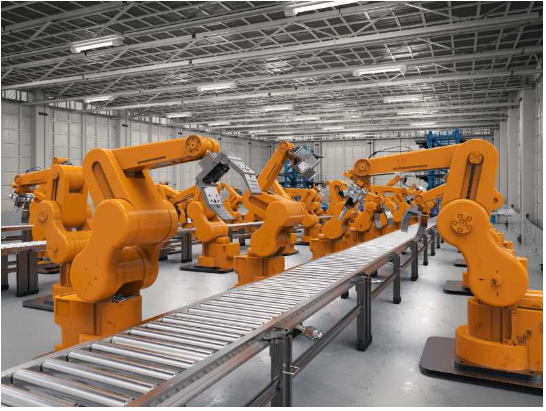
Most small-scale automation projects don’t fail at the planning stage. They fail at year two—when the maintenance bills arrive, the components start wearing unevenly, and the actual ROI looks nothing like what the spreadsheet promised.
The conversation around industrial automation ROI tends to fixate on the obvious line items: robot cost, integration fees, labor reduction. Those numbers are real. But what separates a genuinely profitable automation setup from a break-even headache is usually something far less discussed—the motion components running inside the system, determining whether it holds spec for five years or quietly accumulates repair debt.

Why small-scale automation ROI is harder to nail than it looks
The ROI formula isn’t complicated: total benefits minus total costs, divided by total costs. What makes it complicated is what gets left out of each column.
On the benefits side, operators typically count labor savings and throughput gains. Both are real. Automating a repetitive task that previously required two workers running eight-hour shifts creates immediate, calculable savings. Faster cycle times add output without adding headcount. These are the numbers that make the business case look clean.
The cost side is where the gaps appear.
According to automation implementation data from Qviro’s industrial automation cost analysis, annual maintenance contracts typically run 15-20% of original hardware and software costs. Spare parts and repairs add another 10% on top. For a 40,000 automation setup—modest by industrial standards—that’s potentially
10,000 to $12,000 per year in maintenance overhead alone, before accounting for any downtime.
Downtime is the multiplier no one wants to think about. A single unplanned stoppage on a production line doesn’t just pause output. It triggers a cascade: production schedule disruption, potential order delays, expedited repair costs, staff time redirected away from other tasks. For high-volume lines, industry estimates put unplanned downtime costs in the hundreds of thousands per hour—figures that feel distant to a small-scale operator. But a small assembly cell missing a critical shipping window, or idling a specialized crew while waiting for an emergency repair, can deliver a proportionally equivalent hit to a smaller P&L. The mechanism is the same; the zeroes just look different.
There’s also the customization premium. Industry-specific requirements—food-grade compliance, corrosion resistance in wet environments, precision tolerances in electronics assembly—can add 10-30% to standard system costs. Small operations often underestimate this going in.



The ROI framework from Versatech makes the point clearly: the full calculation needs to account not just for what automation saves, but for the total cost of ownership across the system’s operational life. That’s where component quality stops being a technical footnote and becomes a financial variable.
Motion components: the variable that changes the math
Once a system is running, the components with the highest wear exposure are almost always the motion elements—joints, linkages, and pivot points that cycle thousands of times per shift.
Rod ends are a good case study. In an automated packaging line or conveyor tensioning system, they handle the constant push-pull and angular variation that comes with mechanical motion under load. A standard rod end needs periodic relubrication, wear inspection, eventual replacement—adding labor and parts cost to the maintenance column on a predictable schedule.
The engineering alternative is a PTFE-lined, self-lubricating design. These eliminate the need for external grease entirely, removing one maintenance task from the schedule and—more importantly—removing one failure mode. Misalignment between a linear actuator and its connected linkage, if not managed by a proper spherical bearing, causes side loading. Side loading causes accelerated wear on both the rod end and the actuator itself. Over time, that wear shows up as reduced precision, increased vibration, and eventually premature failure on a component that costs considerably more than the joint that let it down.
For automated systems running high duty cycles, the case for precision-grade motion joints is primarily economic. Using industrial-grade rod ends for automated systems—designed for misalignment compensation under dynamic load—reduces maintenance frequency, extends the life of adjacent components like servo actuators, and keeps system precision tighter over a longer operational window.
The numbers compound quickly. Consider a small packaging line with twelve rod end joint points, each requiring quarterly relubrication under a standard maintenance schedule. That’s 48 service interventions per year. Each one isn’t just the 15-20 minutes of technician time. It’s the system pause, the scheduling coordination, the accumulated variability from reinstallation. Switch to self-lubricating rod ends and that entire task disappears from the maintenance calendar. None of this shows up in the initial purchase price comparison. All of it shows up in the annual maintenance line.
In high-cycle automated systems, the right rod end isn’t a premium—it’s a maintenance cost reduction strategy. Self-lubricating, misalignment-compensating designs remove routine service tasks while protecting adjacent components from wear they shouldn’t be absorbing.
Material selection: why stainless steel ball joints earn their price premium
The same logic applies to ball joints, with an added dimension: environmental exposure.
In standard indoor manufacturing environments, carbon steel components perform adequately. But small-scale operations frequently run in conditions that push past standard—food processing with regular washdowns, coastal facilities with salt air, chemical handling with corrosive vapors, or outdoor assembly stations with wide temperature swings.
In any of these conditions, a carbon steel ball joint starts accumulating surface corrosion. Early-stage corrosion doesn’t immediately cause failure. It increases friction, which increases wear, which degrades motion precision, which eventually produces the kind of erratic system behavior that’s expensive to diagnose and fix. By the time the joint visibly fails, the damage to connected components may already be done.
Stainless steel grades address this through material chemistry rather than coating. Grade 304 covers standard indoor machinery where moisture is occasional but not constant. Grade 316 and 316L add molybdenum to the alloy, which significantly improves resistance to chlorides—the relevant factor in food-grade environments, marine applications, and anything with chemical exposure. For high-strength applications requiring both corrosion resistance and elevated load capacity, 17-4PH precipitation-hardened stainless delivers aerospace-grade performance in a ball joint package.
Temperature range matters too. Stainless steel ball joints with standard PTFE-lined internals maintain performance from -40°C to +150°C, covering the thermal cycling found in most small industrial operations. Applications pushing above that threshold—high-temp ovens, certain welding fixtures—need specialized high-temp liner configurations rather than standard catalog components.
Maintenance-free stainless steel ball joints designed for industrial robotic linkages and automation systems—with hardened contact surfaces and self-lubricating internal geometry—remove the corrosion and relubrication variables simultaneously. In a washdown environment, that’s not a nice-to-have. It’s the difference between a joint that runs its designed service life and one that needs replacement at 40% of it.
The lifecycle math is straightforward: if a ball joint costs 30-40% more than a standard carbon steel alternative but lasts 2.5 times longer in a corrosive environment, the lifecycle cost is lower before you even account for reduced maintenance labor and avoided downtime. The premium pays for itself and then some.
A practical ROI framework for small operations
The industry-standard payback period for straightforward automation—robotic arms handling repetitive tasks, conveyor systems, basic machine tending—runs 6 months to 2 years. More complex integrations stretch to 5 years. For small operations with tighter cash flow, front-loading the ROI curve matters.
Here’s a working framework that applies to most small-scale setups:
Map the motion points first. Identify every joint, linkage, and pivot in the proposed system—these are the highest-wear locations. For each one, note the expected duty cycle (cycles per hour × operating hours per day), the environmental exposure (temperature, moisture, chemical), and the load direction (axial, radial, or combined). Also audit the mounting geometry: even a precision-grade joint can’t compensate for a structural frame that’s out of square. Getting installation right once is itself an ROI decision—it eliminates a category of premature wear that no component upgrade can fix after the fact.
Calculate the maintenance baseline for standard components. Using manufacturer data or industry estimates, calculate annual maintenance cost per component for a standard-grade selection. Include relubrication intervals, inspection time, expected replacement frequency, and parts cost. Multiply across all motion points.
Model the precision component scenario. For PTFE-lined or self-lubricating components, remove relubrication from the schedule. Extend replacement intervals based on rated service life. Apply the same multiplication across all motion points. The difference between these two scenarios is your component-upgrade ROI contribution.
Stress-test the downtime assumption. Assign a conservative cost per hour of unplanned downtime. For a small packaging line, even $500/hour is defensible once you factor in lost throughput, rescheduling, and technician overtime. Multiply by estimated downtime reduction from more reliable components. Even one avoided stoppage per month changes the annual calculation.
Build in the contingency buffer. Best practice for small automation projects is a 10-15% contingency reserve over total projected costs. Factor this into your denominator when calculating ROI. Projects that skip this step consistently underperform their projections—not because the automation failed, but because unforeseen costs eroded the savings margin.
Quick ROI checklist for small-scale automation:
- Annual maintenance cost projected at 15-20% of hardware cost
- Downtime cost per hour estimated and included
- Component replacement intervals based on actual duty cycle, not catalog maximums
- Environmental exposure factored into material selection
- 10-15% contingency reserve in total cost denominator
- Premium component lifecycle savings modeled vs. standard components
One sequencing note worth making explicit: not every component in a system has equal wear exposure. Prioritize the premium component budget at high-cycle joints first. A conveyor tensioning arm cycling 1,200 times per hour accumulates wear 10 times faster than an access panel hinge cycling 120 times per shift. Start where duty cycles are highest.
Components are a lever, not a line item
The conversation about small-scale automation ROI typically ends at the purchase decision. In practice, the ROI story continues for years after installation—written largely by the components running inside the system.
Maintenance-free, precision-grade rod ends eliminate routine service tasks and protect adjacent actuators from premature failure. Stainless steel ball joints matched to the actual operating environment deliver their rated service life instead of degrading early from corrosion. Both represent upfront cost decisions that reduce operating cost over time—exactly the math that separates a profitable automation investment from a break-even one.
For small operations, where margins are tighter and the capital commitment proportionally larger, getting the component specification right from the start is the clearest path to hitting projected ROI within the intended payback window.
The broader automation strategy—robot selection, system integration, software—gets most of the attention. The motion components inside that system are what determine whether it runs at design specification for five years or spends those years accumulating maintenance debt.
Get those right, and the ROI tends to follow.