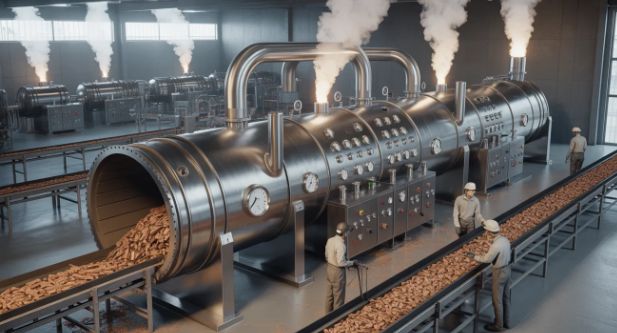
Charcoal remains one of the most essential fuels worldwide, used for cooking, heating, and industrial processes. With rising demand, traditional methods of charcoal production are being replaced by advanced, industrial-scale solutions. Key technologies driving this transformation are the continuous carbonization furnace and charcoal production systems. These systems allow manufacturers to produce high-quality charcoal efficiently, sustainably, and at a large scale, ensuring consistent output and reduced labor costs.
This article explores how continuous carbonization furnaces and charcoal production lines work, their advantages, and why they are crucial for modern charcoal manufacturing.
What Is a Continuous Carbonization Furnace?
A continuous carbonization furnace is an industrial system designed to convert biomass, such as wood, coconut shells, or agricultural residues, into charcoal in an uninterrupted process. Unlike traditional batch kilns, where one batch is processed at a time, continuous furnaces allow raw materials to feed in continuously while finished charcoal is discharged, significantly increasing production efficiency.
How Continuous Furnaces Work
- Raw Material Feeding
Biomass is prepared, sized, and fed into the furnace for processing. - Controlled Carbonization
The material is heated in a low-oxygen environment. This controlled pyrolysis converts the biomass into charcoal while maintaining high calorific value and low ash content. - Gas Recovery
Pyrolysis gases produced during carbonization can be recycled as fuel for the furnace, improving energy efficiency and reducing operational costs. - Continuous Charcoal Discharge
Finished charcoal is automatically removed, cooled, and prepared for packaging or further processing.
Advantages of Continuous Carbonization Furnaces
- High Efficiency: Continuous operation allows for industrial-scale production.
- Consistent Quality: Uniform heating produces charcoal with stable density and minimal ash.
- Labor Savings: Automated feeding and discharge reduce manual labor requirements.
- Energy Efficiency: Gas recovery minimizes external fuel needs.
- Environmental Compliance: Reduces smoke and emissions compared to open-air kilns.
Continuous carbonization furnaces are ideal for manufacturers seeking reliability, large-scale output, and eco-friendly charcoal production.
Charcoal Production Systems: Complete Industrial Solutions
A charcoal production line is an integrated setup that encompasses all equipment necessary for transforming biomass into finished charcoal. These lines streamline the entire process, from raw material preparation to final packaging, ensuring efficiency and consistent quality.
Components of a Charcoal Production Line
- Raw Material Preparation
Biomass is crushed, dried, and screened to optimize carbonization efficiency. - Carbonization System
Continuous carbonization furnaces or other advanced reactors convert raw materials into charcoal. - Cooling and Screening
Charcoal is cooled and screened to ensure uniform size and quality. - Packaging
Finished charcoal is packaged for domestic, industrial, or specialty applications.
By integrating these steps, charcoal production systems reduce labor, minimize waste, and maximize production output.
Benefits of Modern Charcoal Production Technology
1. Efficiency and Scalability
Continuous furnaces and industrial production lines enable high-volume, uninterrupted production, making them suitable for medium to large-scale operations.
2. High-Quality Charcoal
Controlled carbonization produces dense, uniform charcoal with low ash content, ideal for fuel, biochar, or shisha applications.
3. Cost Savings
Automation reduces labor requirements, while energy recovery systems minimize fuel consumption, lowering operational costs.
4. Environmental Sustainability
Modern systems reduce smoke, emissions, and raw material waste, supporting eco-friendly manufacturing practices.
5. Versatility
Production lines can handle various raw materials, including wood, coconut shells, palm kernel shells, and agricultural residues, allowing flexibility for manufacturers.
Applications of Charcoal Produced by Continuous Systems
- Residential Fuel: Charcoal for cooking and heating.
- Industrial Fuel: Used in metallurgy, chemical production, and other industries.
- Shisha and Hookah Charcoal: Uniform briquettes for safe, clean smoking.
- Biochar: Enhances soil fertility, water retention, and crop productivity.
- Activated Charcoal: Used in water purification, filtration, and chemical applications.
High-quality charcoal produced by continuous carbonization furnaces meets diverse market demands and ensures consistent revenue streams.
Choosing the Right Charcoal Production Equipment
When selecting a continuous carbonization furnace or full charcoal production system, consider the following factors:
- Production Capacity
Match equipment to your desired output and business scale. - Raw Material Availability
Ensure a steady supply of biomass suitable for carbonization. - Automation and Technology
Highly automated systems improve efficiency and reduce labor costs. - Quality Standards
Look for furnaces and production lines certified for safety, efficiency, and environmental compliance. - After-Sales Support
Choose suppliers that provide installation, training, and maintenance to ensure smooth long-term operation.
Selecting reliable and efficient equipment ensures consistent charcoal quality, operational efficiency, and profitability.
Conclusion
Investing in a continuous carbonization furnace and a full charcoal production provides manufacturers with modern, efficient, and sustainable solutions for large-scale charcoal production. These systems convert raw biomass into high-quality charcoal suitable for fuel, biochar, industrial, and specialty applications.
With controlled carbonization, energy recovery, and automated operation, manufacturers can achieve consistent product quality, reduce labor and energy costs, and scale production to meet market demands. Adopting these advanced technologies ensures long-term profitability, eco-friendly operation, and a competitive edge in the growing charcoal industry.