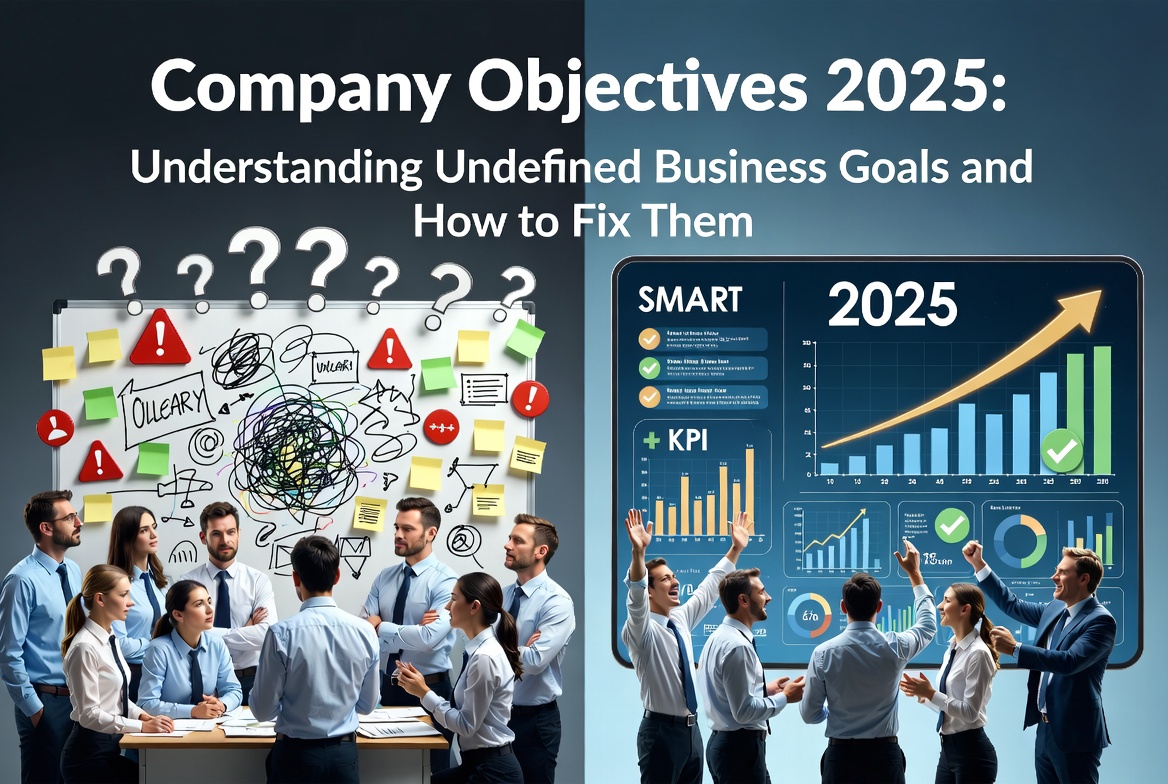
When businesses search for or list None company objectives 2025, it often signals something important: either the company has not clearly defined its goals for the year, or the objectives field in their planning documents has been left blank. This article breaks down what that means, why having clear company objectives matters more than ever in 2025, and how businesses can move from “none” to a concrete, actionable roadmap.
What Does “None” Mean for Company Objectives?
In business planning contexts, seeing the label “None” under company objectives typically means one of the following:
- The company has not formally documented its goals for the year
- Objectives were set informally but never recorded in official strategy documents
- A business is in transition, such as a startup finding its direction or an established company going through restructuring
- Leadership has not aligned on priorities, leaving the objectives field empty in planning tools
In any of these cases, operating without defined company objectives is a significant risk, especially in today’s competitive business environment.
Why Company Objectives Matter in 2025
The business landscape in 2025 is more dynamic and competitive than ever. Economic uncertainty, rapid technological change, and shifting consumer behavior mean that companies without clear objectives are essentially navigating without a map.
Well-defined company objectives serve several critical purposes:
- They align teams around shared priorities and prevent wasted effort
- They provide a benchmark against which progress and success can be measured
- They help attract investors, partners, and talent who want to see a company with clear direction
- They guide resource allocation, ensuring budget and time go toward what matters most
- They create accountability at every level of the organization
Types of Company Objectives Every Business Should Consider
If your company currently has “none” listed under its objectives, here are the key categories of goals worth establishing:
Financial Objectives
These are the most commonly prioritized targets and typically include revenue growth targets, profit margin improvement, cost reduction goals, and cash flow management milestones. Every business, regardless of size, needs clear financial direction for the year.
Operational Objectives
Operational goals focus on how the company runs day to day. Examples include improving production efficiency, reducing customer response times, streamlining supply chains, and adopting new technologies to automate repetitive tasks.
Growth and Market Objectives
These objectives look outward at the market and competitive landscape. A company might aim to enter a new geographic market, launch a new product line, increase market share in an existing segment, or build brand awareness among a new customer demographic.
People and Culture Objectives
Often overlooked but critically important, people objectives cover hiring plans, employee retention goals, training and development initiatives, and efforts to build a more inclusive and engaged workplace culture.
Technology and Innovation Objectives
In 2025, technology objectives are increasingly central to business strategy. This might include implementing artificial intelligence tools, upgrading digital infrastructure, improving cybersecurity posture, or building data analytics capabilities.
How to Set Effective Company Objectives for 2025
Moving from “none” to meaningful objectives requires a structured approach. The most widely used framework for this is SMART objectives, a concept well established in business planning and explained in detail by resources like Investopedia’s guide to SMART goals.
| SMART Criteria | What It Means | Example |
|---|---|---|
| Specific | Clearly defined, not vague | Increase monthly website traffic by 30% |
| Measurable | Has a number or metric attached | Achieve 500 new customer signups per month |
| Achievable | Realistic given current resources | Hire 5 new sales staff by Q3 |
| Relevant | Aligned with broader company direction | Launch a product feature customers have requested |
| Time-bound | Has a clear deadline | Complete rebrand by end of Q2 2025 |
Common Reasons Companies End Up With No Objectives
Understanding why a company ends up with no defined objectives helps prevent the same situation from recurring:
- Leadership disagreement: When senior leaders cannot agree on priorities, no objectives get formally set.
- Rapid growth or change: Fast-moving companies sometimes outpace their planning processes.
- Lack of planning culture: Some businesses, particularly small ones, operate entirely reactively without formal strategy sessions.
- Previous plan failures: If past objectives were never achieved, some leaders become reluctant to set new ones.
- Time pressure: Busy leaders often defer strategic planning, and “none” becomes the default by default.
The Cost of Having No Company Objectives
Operating without clear objectives is not just a planning inconvenience. The real-world consequences can be severe:
- Teams pull in different directions, reducing overall productivity
- Marketing, sales, and operations make decisions without a shared north star
- Investors and stakeholders lose confidence in leadership
- Talented employees become disengaged when they cannot see the bigger picture
- Opportunities are missed because there is no framework for evaluating them
How Digital Strategy Supports Company Objectives in 2025
One area where many companies are now building objectives is digital growth. Whether the goal is increasing online revenue, improving customer engagement, or building brand authority, a strong digital strategy is essential. If you are developing your business objectives and want to understand how digital marketing fits in, this complete guide to digital and online marketing for 2025 is a valuable resource for aligning your online efforts with broader company goals.
Turning “None” Into a Powerful 2025 Strategy
If your company’s current objectives are essentially none, here is a practical starting framework for getting clarity quickly:
- Schedule a leadership alignment session dedicated entirely to objective-setting
- Review last year’s performance honestly and identify the biggest gaps
- Identify three to five priority areas where improvement would have the biggest impact
- Write one clear objective for each priority area using the SMART framework
- Assign ownership of each objective to a specific person or team
- Build a simple quarterly review process to track progress
Final Thoughts
The phrase None company objectives 2025 might seem like a minor data entry issue, but it often reflects a deeper challenge: a business without direction. In today’s environment, clarity of purpose is a genuine competitive advantage. Companies that take the time to define, document, and communicate their objectives are far better positioned to grow, adapt, and succeed than those operating without a plan.
If your company’s objectives are currently undefined, there is no better time than now to change that. Even simple, well-defined goals are infinitely more valuable than none at all.