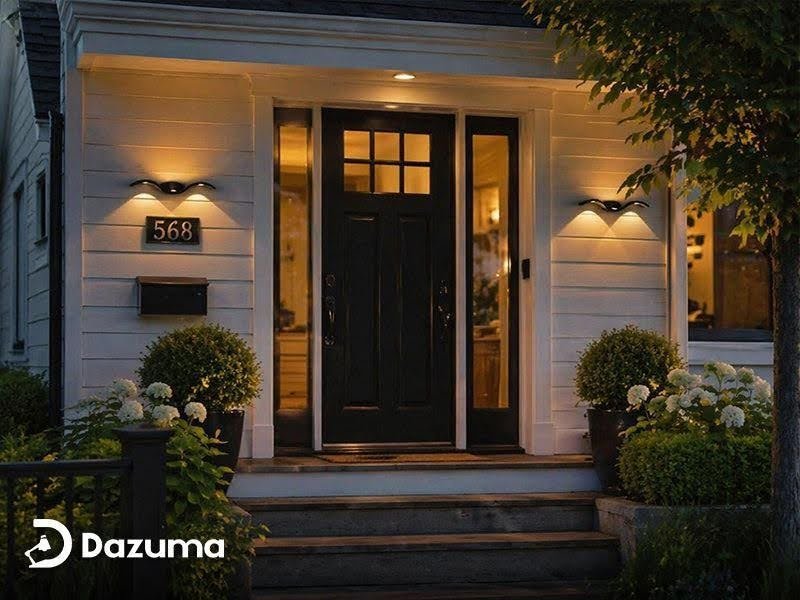
Front entrance lighting should help people find the door, recognise steps, and feel comfortable as they approach the home. Yet many properties rely on one overly bright fixture or a collection of lights that do not work together. The result may technically be illuminated but still feel harsh, flat, or difficult to navigate.
A better entrance does not require dozens of fixtures. Avoiding a few common mistakes can improve comfort, appearance, and practical visibility while allowing the home’s architecture to remain the focus.
1. Depending on One Extremely Bright Light
A single high-output lamp above the door often creates a bright centre surrounded by deep shadow. It can make it harder to see the path beyond the porch and may produce uncomfortable glare for guests waiting at the entrance.
Use several gentler layers instead. A porch fixture can identify the destination, while low path or step lights clarify the route. The brightness should change gradually as people move toward the door.
2. Choosing Porch Fixtures That Are Too Small
Fixtures that look substantial in a product photograph can appear tiny beside a wide door, tall columns, or a deep porch. Undersized lighting may not provide enough visual presence when viewed from the street, leaving the entrance looking unfinished.
When comparing Porch Lighting, consider the proportions of the entire entrance rather than the door alone. Look at the overhang, trim, sidelights, columns, and distance from the pavement. A pair of appropriately scaled sconces may feel more balanced than one small ceiling fixture.
Always check the listed dimensions. Product images rarely show how large a light will appear on your particular wall or ceiling.
3. Ignoring Glare at Eye Level
A visible bare bulb may look bright without helping people see the lock, step, or ground. Wall lights mounted near eye level can be especially uncomfortable if clear glass exposes a powerful bulb directly.
Frosted glass, shields, hoods, and downward-directed designs can soften the source. After installation, approach the door from the driveway and walkway to make sure the light is not shining into people’s eyes.
4. Treating Every Exterior Wall the Same
Repeating an identical fixture at equal brightness across every wall can make the exterior look flat. Different locations have different jobs: the front door needs recognition and comfortable facial visibility, while a side passage may need focused downward light and a patio may benefit from softer ambience.
Choose Outdoor Wall Lighting according to placement and beam direction. An up-and-down fixture can reveal brick or stone texture, a lantern can create a welcoming entrance, and a shielded light can support movement along a narrow side yard. Coordinated finishes can connect these designs without making every fixture identical.
5. Mixing Unrelated Light Colours
A warm porch light beside a cold blue wall light can make the entrance feel disconnected. Colour temperature affects how brick, timber, paint, planting, and skin tones appear, so obvious differences are noticeable even when the fixtures themselves match.
Warm white light generally creates a comfortable residential atmosphere. Whichever colour you choose, keep nearby sources reasonably consistent unless a deliberate contrast serves a specific feature.
6. Lighting Every Surface Equally
When the door, path, walls, plants, and driveway all have the same brightness, the eye does not know where to look. The entrance loses depth, and additional light may increase glare without improving navigation.
Create a hierarchy. Make the door one of the clearest points, use softer illumination along the route, and highlight only one or two architectural or landscape features. Allowing some shadow makes the important areas easier to understand.
7. Forgetting the View From Inside
Outdoor lighting is part of the interior view after dark. A poorly aimed fixture can shine through bedroom or living-room windows, while a thoughtfully lit tree or wall can extend the sense of space beyond the glass.
Check the scheme from the rooms facing the entrance. Adjust fixture angles, shields, and output until the exterior feels pleasant from both directions. Timers, photocells, and suitable controls can also prevent lights from remaining at full brightness when they are not needed.
Plan Before You Install
Sketch the route from the street or driveway to the door and assign every fixture a purpose. Confirm that each product is intended for its level of exposure to rain, moisture, dust, and temperature changes. For new wiring or uncertain electrical work, use a qualified professional.
Good entrance lighting should feel almost effortless. By choosing the right scale, controlling glare, coordinating light colour, and building a clear hierarchy, homeowners can create an exterior that feels safer and more welcoming without making it excessively bright.