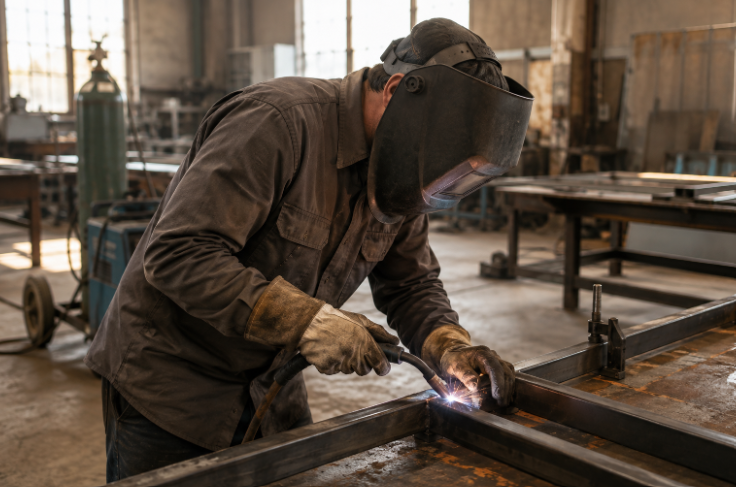
Welding produces more than a bright arc. Sparks, hot metal particles and radiant heat can reach a worker’s sleeves, chest, neck and waist. A shirt that performs well during ordinary construction or maintenance work may not provide suitable protection in this environment.
Choosing welding workwear therefore involves more than finding a thick, long-sleeve shirt. Workers need to consider how the material reacts to heat, where sparks may enter and how the shirt works with the rest of their PPE.
Can a Regular Cotton Shirt Be Used for Welding?
Cotton is commonly worn in workshops because it does not melt like many untreated synthetic fabrics. That does not make every cotton shirt appropriate for welding.
Untreated cotton can ignite when exposed to enough heat and may continue burning after the ignition source is gone. Oil, grease and other combustible contaminants can make this problem worse. A thick cotton shirt may resist small sparks better than a thin casual shirt, but thickness is not proof of flame-resistant performance.
Whether an ordinary cotton shirt is acceptable depends on the welding process and the employer’s hazard assessment. If flame-resistant clothing is required, a regular cotton work shirt cannot replace a properly labeled FR garment.
Workers should also check fabric blends. Some everyday work shirts contain polyester or other fibers that may melt under intense heat. The fiber content label should be reviewed before the shirt is worn near welding operations.
Regular Work Shirts and Welding Shirts Compared
Although the two garments may look similar, their intended uses are different.
| Feature | Regular work shirt | FR welding shirt |
| Primary purpose | Comfort and general durability | Protection against identified thermal hazards |
| Fabric | May contain untreated cotton or synthetics | Flame-resistant or FR-treated material |
| Heat performance | Usually not tested or stated | Protective performance should be documented |
| Closures | Selected mainly for convenience or appearance | Designed to remain secure and reduce exposure |
| Pocket design | Often open for easy access | Secure flaps may help keep sparks out |
| Safety label | Fiber and care information | May include standards, CAT and arc rating |
| Use with PPE | General compatibility | Intended to integrate with welding PPE |
Protective welding shirts are designed to resist ignition and limit continued burning. Some models are also tested for electrical arc hazards. However, an FR label does not automatically mean that a shirt is suitable for every welding process or that it has an arc rating.
Garment ratings, coverage and closure design should be checked when comparing flame-resistant shirts for welding.
Think About Where Sparks Can Enter
The front of the shirt receives much of the attention, but sparks often enter through smaller openings. Cuffs, pockets, the collar and the gap at the waist can all become collection points for hot particles.
Sleeves should remain long enough to cover the wrists while the worker reaches or bends. Secure cuffs help prevent sparks from entering the sleeve and should overlap correctly with welding gloves. Rolling the sleeves creates exposed skin as well as fabric folds that can trap hot debris.
The collar should cover the lower neck without interfering with the welding helmet. The shirt front should remain closed, and the hem should maintain coverage when the worker leans forward or works overhead.
Fit also matters. A tight shirt can pull away from the wrists or waist during movement. Excessively loose fabric may catch on equipment or create folds where sparks collect. The best fit provides full movement without unnecessary bulk.
Examine Closures and Pockets
Buttons and snaps both have practical advantages. Covered buttons reduce direct exposure to sparks, while snaps may allow a garment to be removed quickly. The important question is whether the closures stay secure during normal movement and form part of an appropriately tested garment.
Missing buttons, broken snaps or damaged plackets can leave parts of the body exposed. A shirt with defective closures should be repaired according to approved procedures or removed from service.
Pocket placement deserves similar attention. Open chest pockets can catch sparks, slag and grinding debris. Covered pockets with secure flaps may reduce this risk, especially when the worker bends forward. Flammable objects and unnecessary tools should not be stored in shirt pockets during welding.
Choose Fabric Weight for the Welding Conditions
A lightweight FR work shirt can improve mobility and reduce heat buildup in warm environments. It may be practical for jobs with limited spark exposure when the hazard assessment permits it.
Midweight shirts offer a balance between comfort and durability for general fabrication and shop work. Heavy canvas or similar materials may feel more substantial around frequent sparks and abrasive surfaces. Workers considering a heavier garment can review an 8.5 oz stretch canvas FR welding shirt as one example, while confirming that its current rating and label meet their workplace requirements.
Fabric weight alone should never determine the choice. A heavier garment is not automatically more flame resistant or more highly arc rated. Fiber construction, garment design and tested performance are more meaningful than the number of ounces by itself.
The expected workload also matters. Heat stress can reduce concentration and encourage workers to open collars or roll sleeves. If a heavy shirt makes correct wear difficult, a lighter rated garment combined with suitable additional PPE may be the better system.
Use the Label as a Short Safety Checklist
Before wearing an FR welding shirt, check the permanent label for:
- The manufacturer and garment identification
- Flame-resistant or arc-rated classification
- Arc rating in cal/cm², when electrical exposure is relevant
- CAT designation, if provided
- Applicable standards, such as ASTM F1506 or NFPA 2112
- Washing, drying and repair instructions
NFPA 70E may apply when electrical arc-flash hazards are present, while NFPA 2112 addresses garments for short-duration thermal exposure from fire. ASTM F1506 covers flame-resistant and arc-rated protective clothing for certain electrical hazards.
These standards address different risks. A shirt should be selected for the hazard identified by the employer rather than simply because several standard numbers appear in its description.
Match the Shirt to the Welding Task
For light or occasional welding with limited sparks, an appropriately rated FR shirt may provide the required body coverage. General shop fabrication may call for a midweight shirt plus gloves and task-specific eye and face protection.
Processes producing heavier spatter, sustained heat or overhead sparks may require leather sleeves, a welding apron or a full welding jacket over the shirt. The additional layers should overlap correctly and should not restrict movement.
Gloves should cover the cuffs without leaving the wrists exposed. A welding helmet protects the eyes and face, but safety glasses may still be required underneath. Respiratory and hearing protection may also be necessary depending on the process, materials and ventilation.
An FR shirt does not replace any of these items. Its role is to protect the covered upper body as one part of a complete PPE system.
Select the Whole System, Not Just the Shirt
The most suitable welding shirt is the one that matches the actual process, exposure level and required PPE. Material, weight, closures and coverage all influence performance, but none should be evaluated in isolation.
Workers should inspect the garment before every shift, keep it properly closed and follow its care instructions. When combined with suitable gloves, a helmet and any required apron, sleeves or jacket, a well-chosen FR welding shirt can provide reliable coverage without preventing the worker from moving comfortably and safely.