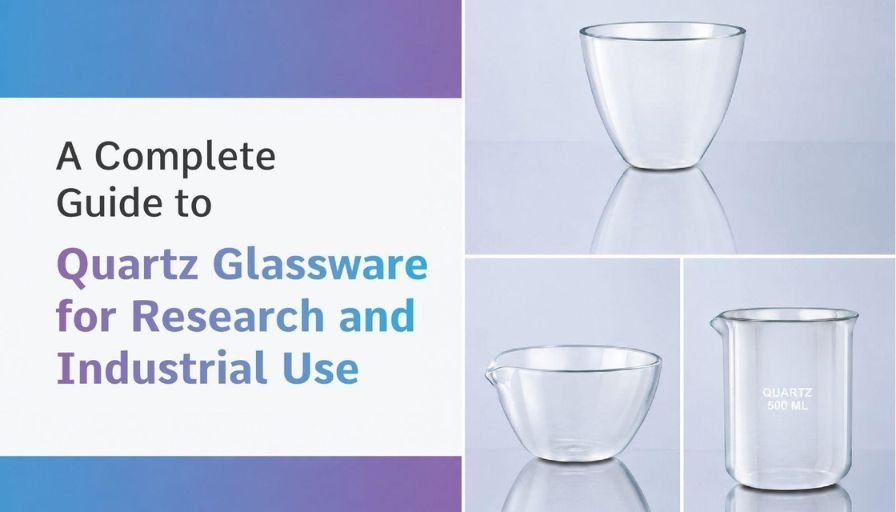
In the laboratory, the choice of material often dictates the success of an experiment. While borosilicate glass serves many general purposes, certain applications require superior thermal and chemical resistance. This is where fused quartz becomes the standard. It is composed of high-purity silica and offers exceptional properties that standard glass cannot match.
Understanding the specific capabilities of this material helps laboratory professionals select the right equipment for spectroscopy, elemental analysis and high-temperature synthesis. This guide outlines the properties, types and maintenance protocols associated with high-grade quartz glassware.
Properties and Benefits of Quartz Glassware
Quartz glass differs from standard glass because it lacks fluxing agents, resulting in a structure composed almost entirely of silicon dioxide. This purity imparts several benefits that are critical for analytical accuracy.
Key Characteristics
The following table highlights the primary physical and chemical properties that make fused quartz essential for rigorous laboratory work.
| Property | Description | Benefit |
| Purity | High silica content (>99.9%) | Prevents sample contamination during analysis. |
| Thermal Stability | Very low coefficient of thermal expansion | Withstands extreme temperature changes without cracking. |
| Optical Clarity | Transparent to UV and IR light | Essential for spectrophotometric applications. |
| Chemical Inertness | Resistant to acids (except HF) and neutral salts | Ideal for holding corrosive chemical compounds. |
These properties ensure that the vessel does not interfere with the reaction or the measurement taking place inside it.
Types of Quartz Glassware
Laboratory glassware made from quartz is available in several formats, each designed to support specific analytical or preparatory tasks.
- Beakers and Flasks: These vessels are used for heating reagents to temperatures that exceed the limits of borosilicate glass. They are commonly applied in fusion reactions, ash determination and other high-temperature procedures.
- Test Tubes and Vials: Tubular quartz vials are produced by converting high-purity glass tubing into finished forms. This manufacturing approach supports applications where chemical purity and thermal stability are critical to analytical outcomes.
- Cuvettes: One of the most widespread uses of quartz glassware is in cuvettes for UV–Vis spectroscopy. Quartz permits ultraviolet light transmission, unlike standard glass, which absorbs UV wavelengths and interferes with measurements.
Selecting the appropriate vessel geometry and material grade helps ensure experimental results remain accurate, consistent and reproducible.
Applications in Research
Research laboratories rely heavily on the optical and thermal resilience of quartz.
- Chemical Synthesis: Certain organic and inorganic syntheses involve temperatures approaching or exceeding 1000 °C, where quartz vessels can maintain structural integrity due to their low thermal expansion and high softening point.
- Spectroscopy: In UV-Vis spectroscopy, the container must be invisible to the detector. Quartz provides the necessary transparency range from ultraviolet to infrared.
- Cell Culture: In specialised biological or analytical environments, the inert nature of quartz helps minimise ionic contamination, which is critical where material purity and sterility are tightly controlled.
Research accuracy often depends on the container’s invisibility to the analytical instrument.
Applications in Industry
Beyond the academic lab, industrial sectors utilise quartz glassware for large-scale manufacturing and quality control processes.
- Semiconductor Manufacturing: The production of silicon wafers requires an environment free from metallic impurities. Quartz tubes are used in diffusion and oxidation furnaces to maintain this purity.
- High-Intensity Lighting: Due to its ability to withstand high internal pressure and heat, quartz is the material of choice for halogen and arc lamps.
- Sterile Environments: The material’s resistance to high heat makes it easy to sterilise. This property is particularly important for certain microbiological lab instruments and vessels used in pharmaceutical and analytical production environments.
Industrial applications demand consistency and durability to maintain continuous production cycles.
Care and Maintenance
Although quartz is robust regarding heat and chemicals, it is mechanically fragile and requires careful handling to maintain its optical properties.
- Cleaning Procedures: Use specific solvents or acid baths to clean residues. Avoid abrasive brushes that can scratch the optical surfaces of cuvettes.
- Handling Precautions: Do not touch the optical faces of quartz cells with your bare hands. Skin oils can degrade optical performance when exposed to heat and may interfere with UV transmission over repeated use.
- Storage Guidelines: Store items in padded racks or original cases. Ensure they are dry before storage to prevent bacterial growth or mineral spotting.
Proper maintenance extends the lifespan of the glassware and ensures that optical measurements remain precise over time.
Conclusion
Fused quartz remains an essential material in modern scientific and industrial environments. Its combination of thermal shock resistance, chemical inertness and optical transparency enables reliable performance in demanding analytical and high-temperature applications.
Whether used in microbiological lab instruments where sterility and material purity are critical, or in spectrophotometric systems that require precise optical transmission, selecting the appropriate glassware directly influences experimental accuracy and consistency. To ensure suitability for specific processes, laboratory professionals should consult manufacturer-provided e-catalogues and technical datasheets from established laboratory suppliers, such as Borosil Scientific, which outline material specifications, tolerances and recommended use conditions.