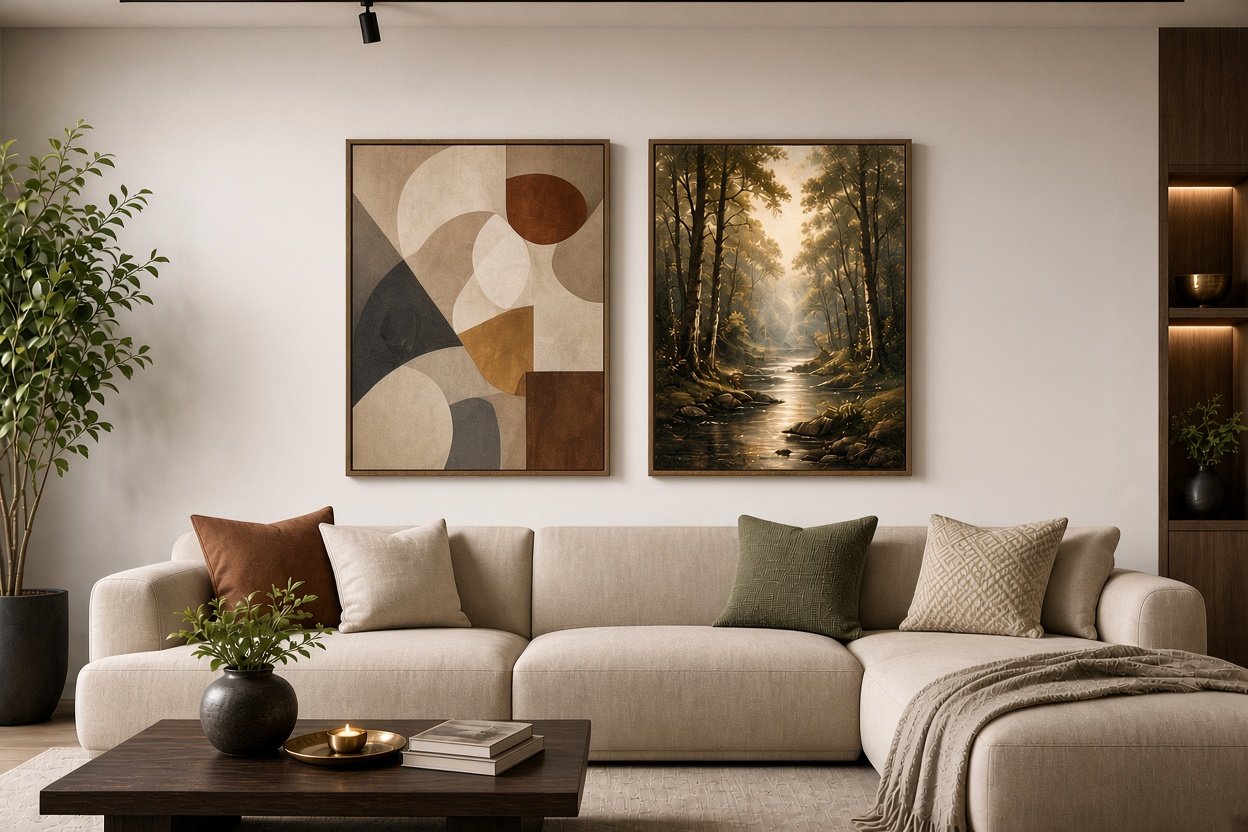
The painting above your sofa is something you will see while having tea, talking to friends or settling down after work. It makes sense to choose an image you enjoy, rather than one that simply fills the space.
Abstract designs, nature scenes and Krishna paintings each offer plenty of possibilities. You might prefer loose shapes in warm colours, a quiet stretch of countryside or a familiar devotional scene. A canvas painting for wall decor can help bring those details together. Begin with the kind of picture you would like living with, then work out its size and placement.
Abstract Paintings for a Simple Living Room
Abstract art gives you room to choose by colour, shape and texture. You do not have to identify a subject or explain what the painting means before deciding that you like it.
For a living room with a beige sofa and wooden furniture, try broad shapes in rust, cream and brown. The colours can relate to the furniture while giving the wall something interesting to look at.
If the room already has bright cushions or a patterned rug, consider a canvas with a smaller colour palette. A black and white composition or pale blocks of colour might feel easier alongside those details.
Large brushstrokes can be enjoyable from across a room. Fine patterns invite a closer look, so think about whether people will usually see the picture from the sofa or while walking past.
Nature Scenes That Suit Everyday Spaces
A nature painting can remind you of somewhere you have visited or a place you would like to go. That personal connection is often a better reason to choose it than matching every colour in the room.
Think beyond a green forest. You could choose a coastal view, a cloudy hillside, a garden scene or branches against a pale sky. Each gives you a different combination of colours and shapes.
Above a long sofa, a wide landscape can follow the horizontal lines of the seating. Beside a reading chair, a smaller botanical canvas may be enough to make the corner feel considered.
If you keep several indoor plants, try a landscape with some open sky or water. It can introduce variety while still fitting the natural elements around it.
Krishna Art With Personal Meaning
For some households, devotional art belongs in the living room because it reflects family beliefs and familiar stories. Choose a scene you connect with and would feel comfortable displaying in a shared space.
A lord krishna canvas painting can become the central picture above a console or on a clear wall near the seating area. You might prefer a flute portrait, a Radha Krishna composition or a scene with cows and trees.
Look at the treatment as well as the subject. Detailed traditional imagery and simpler contemporary interpretations can create quite different displays. The surrounding furniture does not need to be traditional for either approach to work.
Leave some space around a detailed painting. Too many small objects beside it can distract from the figures and make the arrangement harder to appreciate.
Choose One Large Canvas or a Small Group
One large painting is useful when you want a clear point of interest. It also means making fewer decisions about spacing, frame finishes and how different pictures relate.
A pair or a set of three offers another approach. You could hang related landscapes together or choose abstract pieces with a repeated colour. Measure the complete arrangement, including the gaps, before deciding whether it fits.
Small pictures can work well above a narrow cabinet or between windows. They may feel less convincing when spread too far apart across a large empty wall.
Cut paper to the proposed dimensions and try the arrangement first. Look at it from your usual seat, where you will probably spend the most time seeing it.
For a small rented living room, start with a single canvas you can move easily if the furniture changes. Place it above a cabinet rather than planning an entire gallery wall. You can add another picture later once you know how the first one looks at home.
Connect the Painting With Your Colours
Choose one or two colours from the artwork and see whether they appear elsewhere in the room. A blue detail might relate to a cushion, while a soft ochre could work beside warm wood.
You do not need exact matches. Slight differences can make a room feel more relaxed than buying everything in the same shade.
For example, an abstract painting with cream and terracotta can sit above a neutral sofa. A landscape with dusty greens may suit pale walls and woven furnishings. A colourful devotional picture can stand out against a plain background without needing matching accessories everywhere.
Mix Subjects With a Shared Detail
You can enjoy more than one style in the same living room. A small nature canvas near a bookshelf can sit comfortably with a larger abstract piece above the sofa.
Give them something in common, such as similar frames or a repeated background colour. Keep enough distance between strong pieces so each can be seen properly.
If one painting has particular personal or religious importance, let that guide the arrangement. Place it where it feels appropriate to your household, then choose supporting pictures that do not crowd it.
Check the Details Before Ordering
Save a photograph of your room before browsing Artociti, so you can compare shortlisted pieces with the actual furniture and wall colour. Product photographs alone make size difficult to judge.
Check whether the listing describes a print or a hand painted work, whether framing is included and what hanging fittings are supplied. Look for close views of the surface and edges.
Finally, choose a position where the artwork can be enjoyed comfortably and follow its care instructions. Buy the picture you keep returning to. It is usually a more satisfying choice than something selected only to finish the room quickly.