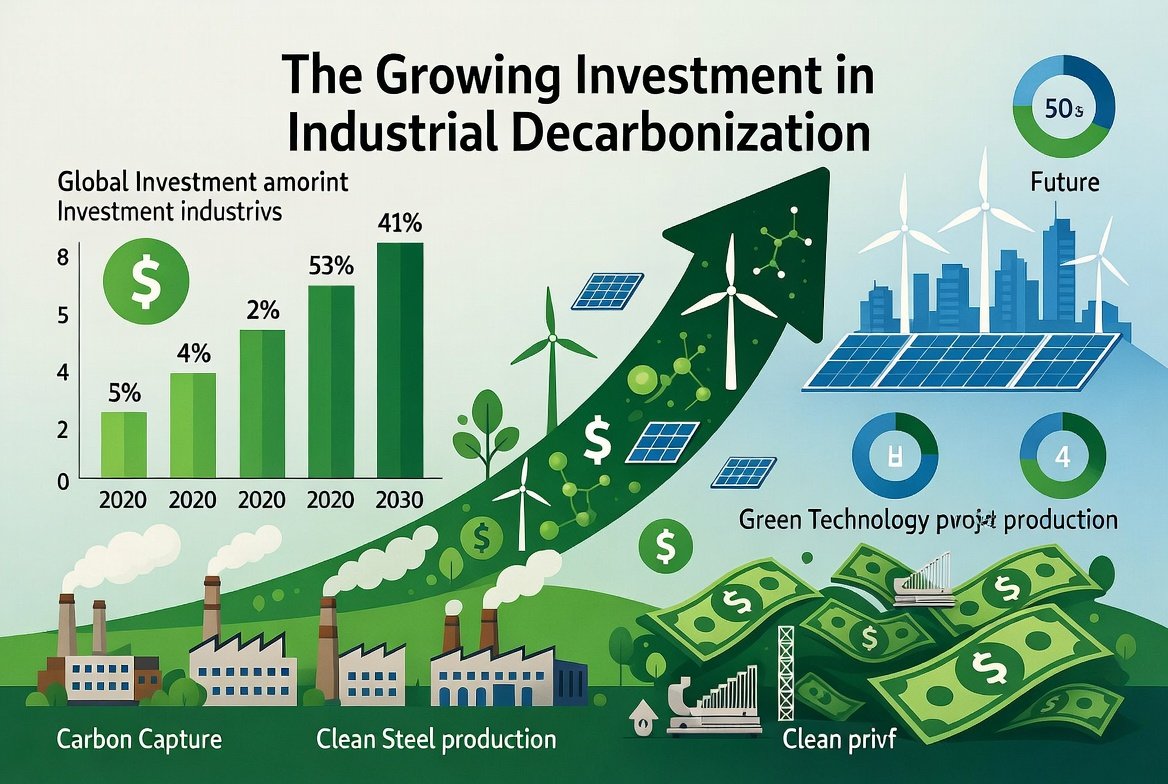
Industrial decarbonization has become one of the defining priorities of the global energy transition. As governments introduce more ambitious climate policies and businesses strengthen their environmental commitments, investment in technologies that reduce greenhouse gas emissions continues to accelerate. From cleaner manufacturing processes to carbon capture and storage, companies across multiple sectors are exploring practical ways to lower their carbon footprint while maintaining productivity and competitiveness.
Heavy industries such as cement, steel, chemicals, refining, and power generation account for a significant share of global carbon dioxide emissions. Unlike some sectors that can reduce emissions through electrification alone, these industries often produce carbon dioxide as an unavoidable part of their core processes. This has increased interest in technologies that can capture emissions before they enter the atmosphere, allowing facilities to continue operating while reducing their environmental impact.
A Shift from Ambition to Implementation
In recent years, industrial decarbonization has moved beyond long-term planning and into active deployment. Public funding programs, private investment, and international partnerships are helping bring innovative technologies from demonstration projects to commercial applications.
Many organizations now view decarbonization not simply as a regulatory obligation but as a strategic investment. Improving operational efficiency, reducing future compliance costs, and strengthening sustainability credentials can all contribute to long-term business resilience.
As investments grow, companies start seeking technologies that can be integrated into existing facilities without requiring a complete infrastructure replacement. This has created strong demand for modular and scalable solutions that minimize disruption while delivering measurable emissions reductions.
Carbon Capture Continues to Advance
Carbon capture has become one of the fastest-growing areas of industrial climate technology. Modern systems are becoming more compact, efficient, and flexible, making them suitable for a wider range of industrial applications than was previously possible.
Engineering improvements have reduced the physical footprint of many capture systems while lowering installation complexity. As these technologies mature, they are expected to play an increasingly important role in helping industries achieve their net zero objectives alongside renewable energy, electrification, and energy efficiency measures.
Continued investment is also encouraging collaboration between technology developers, engineering firms, and industrial operators, allowing innovative solutions to move more quickly toward commercial deployment.
Collaboration Drives Innovation
Strategic partnerships have become an important feature of the industrial decarbonization landscape. By combining specialist technology with engineering and project delivery expertise, companies can accelerate the development and deployment of low-carbon solutions. One example is the collaboration between Carbon Clean and Samsung Engineering to explore onboard carbon capture applications for shipping decarbonization. Their joint development agreement focuses on adapting compact modular carbon capture technology for use aboard ships, highlighting how partnerships are helping expand carbon capture into new sectors while addressing emissions from maritime transport.
Investment Is Expanding Worldwide
Support for industrial decarbonization is growing across North America, Europe, Asia, and the Middle East. Governments are introducing incentives that encourage investment in low-carbon technologies, while financial institutions are increasingly directing capital toward projects with measurable environmental benefits.
Private sector investment is also rising as organizations recognize the commercial opportunities associated with cleaner industrial processes. Businesses that successfully reduce emissions may improve operational efficiency, strengthen relationships with customers and investors, and prepare for evolving regulatory requirements.
Looking Ahead
Industrial decarbonization will require a combination of solutions rather than reliance on any single technology. Renewable energy, energy efficiency, alternative fuels, electrification, and carbon capture each have important roles to play depending on the needs of individual industries. The pace of investment seen today suggests that industrial decarbonization will remain a major focus for businesses, governments, and technology developers for many years to come. Continued cooperation between engineering companies, technology providers, and industrial operators will be essential in building a more sustainable industrial future.